
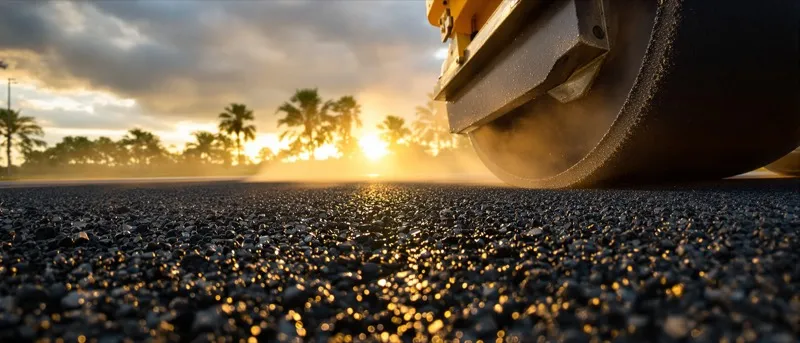
Asphalt compaction is what turns loose hot mix into durable pavement. The basics are simple: roll while the mix is hot enough to move, use a consistent rolling pattern, place lifts at the right thickness for the mix and give joints extra attention. Getting density right is one of the biggest factors in how long a pavement lasts.
Why compaction matters
Hot mix leaves the paver with a lot of air in it. Rolling squeezes that air out and locks the stone together. When a mat is under-compacted, the extra air voids let in water and air, which can lead to raveling, cracking, moisture damage and rutting. Over-rolling can cause problems too, such as crushed aggregate or a shoved surface. The goal is the target density in the spec, reached efficiently.
Temperature is the clock
Compaction only works while the binder is warm enough to let the stone move. As the mat cools, it stiffens, and rolling does less and less. That means the crew is always working against the clock.
- Know your mix's range. The mix design or project spec sets the temperatures to follow. Ask the plant if you are unsure.
- Check temperature behind the screed. An infrared thermometer gives a quick read on the mat.
- Watch the conditions. Thin lifts, wind, a cool or damp base and cloud cover after rain all shorten the window. Hot, still summer days lengthen it.
Mix that arrives at the right temperature gives the crew the full window. At EAM's Gencor plant, mix temperatures and consistency are monitored from batch to batch, and covered loads on short hauls help that heat reach the job.
The three phases of rolling
Breakdown rolling
The first passes, made right behind the paver while the mat is hottest, do most of the densification. A vibratory steel drum roller is common here. Keep the breakdown roller close to the paver so it works the mat at its most workable temperature.
Intermediate rolling
The second phase continues building density while the mat is still warm. Pneumatic tire rollers are often used because their kneading action helps seal the surface, though steel rollers are also common.
Finish rolling
The last passes remove roller marks and smooth the surface, usually with a steel drum roller in static mode. Finish rolling adds little density. Its job is appearance and smoothness.
Rolling pattern basics
A consistent pattern gives the whole mat even coverage.
- Run the drive wheel or drum toward the paver on the first pass to limit shoving.
- Overlap each pass and cover the full width before moving on.
- Keep roller speed steady. Rolling too fast reduces the effort each pass delivers.
- Do not stop or turn the roller on the hot mat. Change direction smoothly and stagger stopping points.
- Count passes and keep the count the same across the mat.
Many crews set up a test strip at the start of a job, checking density after each pass to find the pattern that reaches target. Then they repeat it.
Lift thickness and mix size
A lift has to be thick enough for the stones to move past each other and seat. A common rule of thumb is a compacted lift of at least three times the nominal maximum aggregate size for fine-graded mixes and four times for coarse-graded mixes. Lifts that are too thin cool fast and resist compaction. Lifts that are too thick can be hard to compact through the full depth.
This is one reason the mix matters. An SP-9.5 fine surface mix can be placed in thinner lifts than an SP-19 structural mix. Review gradations on the specifications page and match lift thickness to the mix.
Joints and edges
Joints are where pavements often fail first, so they deserve extra care.
- Longitudinal joints: overlap the hot lane slightly onto the cold lane, and roll with most of the drum on the hot side first so mix is pushed into the joint.
- Transverse joints: cut back to a clean, full-depth edge and tack it before restarting.
- Unsupported edges: roll carefully to avoid pushing the edge out.
- Tack coat: a uniform tack layer between lifts and on vertical faces helps bond. EAM offers TAC (tack coat) with its mixes.
Florida conditions
Heat and rain shape compaction here.
- Summer heat can keep a mat workable longer, but a heavy roller on a soft mat can shove it. Watch for tender behavior and adjust timing.
- Never pave on standing water or a soaked base. Wet surfaces pull heat out of the mat fast.
- After a storm, a damp, cool base shortens the compaction window. Move rollers in sooner.
- Polymer-modified mixes, such as those with PG 76-22 binder, can be stiffer to work. Follow the temperatures in the mix design.
Checking density
Density is usually checked with a nuclear or non-nuclear gauge during paving and confirmed with cores where the spec requires it. Checking early and often lets the crew adjust the pattern before a whole day of paving misses target.
Questions about your mix?
The EAM team can help with mix selection, quantities and timing. Learn more on the services page, call or text (772) 494-6077, or reach us through the contact page.