
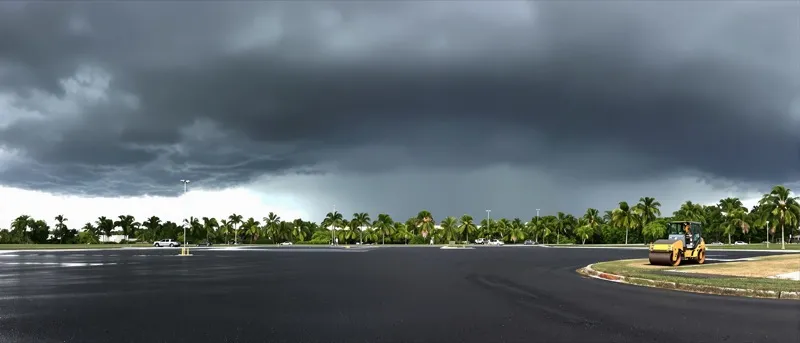
Asphalt paving in Florida weather comes down to one habit: plan around the afternoon storm instead of hoping it skips you. On the Treasure Coast, the wet season brings frequent showers and thunderstorms, so the crews who start early, order smart and keep a close eye on the radar lose the fewest days.
Here is how to schedule hot mix work around Florida rain, and how our Vero Beach plant can help.
Why rain and hot mix do not mix
Hot mix asphalt needs a dry, sound surface and enough heat to be compacted. Rain works against both:
- Bond. Water on the surface keeps tack coat and the new mat from bonding to the layer below.
- Cooling. A wet surface pulls heat out of the mix quickly, shrinking the window for compaction.
- Density. A mat that cools before it is fully rolled is harder to bring to density, which can shorten pavement life.
- Base problems. Saturated base and subgrade can soften and move under rollers and traffic.
As a general rule, do not place hot mix on standing water or a wet base, and follow the project specification for surface and weather limits.
Build the day around the forecast
Summer storms on the Treasure Coast often build in the afternoon. That pattern is not guaranteed, but it shapes good planning:
- Start early. Get the paver moving as soon as conditions allow so the bulk of placement happens before afternoon storms.
- Front load tonnage. Schedule the heaviest trucking in the morning hours.
- Watch radar, not just the forecast. A crew member checking live radar can call a stop before trucks are loaded.
- Keep a smaller plan B. Have patch work or a short section ready if the main area is too wet.
Order in a way that reduces waste
Rain is hardest on contractors who order a full day of mix and then lose the afternoon. A few habits help:
- Know your tonnage. Use the asphalt tonnage calculator to estimate each section, so you can order by section rather than all at once.
- Stage your loads. Talk with our team about timing so trucks are not loaded far ahead of when the paver can use them.
- Stay in touch. If a storm cell is building, call the plant at (772) 494-6077 before the next truck loads.
- Tarp every load. Covered beds hold temperature better and keep rain off the mix during the haul.
Short hauls help in unsettled weather
When the weather window is tight, haul time matters. Our central Vero Beach location serves Indian River, Brevard, St. Lucie and Martin counties, so trucks spend less time on the road and mix arrives warmer. That gives the crew more room to place and compact before conditions change.
Prep and inspect after a storm
Before restarting after rain, walk the area:
- Check for standing water, especially at low spots, gutters and drainage structures.
- Blow or sweep off water and debris where the specification allows.
- Confirm the base is firm and not pumping under load.
- Reapply tack where it has been washed off, and let it set before paving.
Choose mixes that hold up to Florida conditions
Rain is not only a scheduling issue. It is also part of what pavement has to survive for years. Some mixes are built with wet weather and heat in mind:
- Open-graded friction course (OGFC) improves surface drainage and reduces hydroplaning on high-speed roads.
- Porous asphalt lets water infiltrate, which can support stormwater management on parking lots.
- Polymer-modified PG 76-22 holds up better under heat and heavy loads at intersections and truck routes.
- Superpave gradations such as SP-9.5, SP-12.5 and SP-19 are paired with binders suited to traffic and climate.
Review standard mixes on our specifications page and confirm availability with our team for your project.
Use the dry season wisely
Drier months are the natural time to schedule larger pours and jobs that cannot easily stop midstream. If you have flexibility, plan big municipal or commercial paving for drier stretches and keep smaller, easily paused work for the wet season. Whatever the month, ordering ahead helps us schedule production and have your mix hot and ready.
Communicate with the owner about weather days
Rain delays are easier to manage when everyone expects them. Before a wet season job starts, agree with the owner or general contractor on how weather days will be handled, who makes the call to stop, and how much notice is needed to restart. Clear expectations prevent pressure to pave on a surface that is not ready, which is how short-lived pavement gets built. A short daily check-in on the forecast keeps the crew, the owner and the plant aligned.
Plan your next pour with EAM
Plant pickup runs Monday through Friday, 8am to 5pm, first come, first served, with weekend and after-hours pickup by request. If weather pushes your job around, call us and we will work with you on timing. Reach us through the contact page or at (772) 494-6077.