
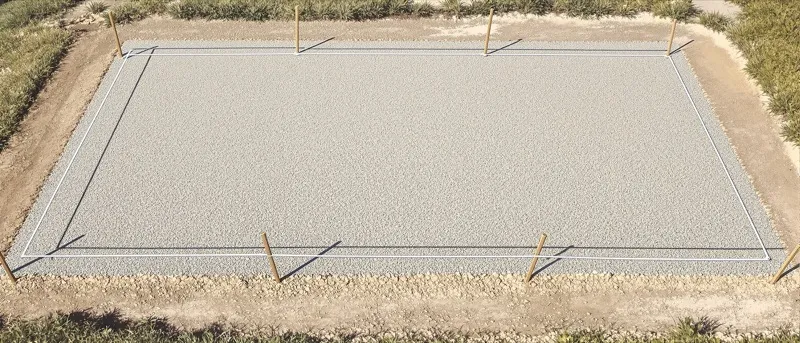
To estimate asphalt tonnage, multiply length by width by compacted thickness in feet, multiply by the mix density in pounds per cubic foot, and divide by 2,000. Our free asphalt tonnage calculator does this for you using a standard density of about 145 pounds per cubic foot, which you can adjust for your mix.
Below is the formula step by step, two worked examples, and the field factors that should adjust your final order.
The formula
Tons = length (ft) x width (ft) x thickness (in) / 12 x density (lb/ft3) / 2,000
- Length and width give the area in square feet.
- Thickness divided by 12 converts inches to feet, giving volume in cubic feet.
- Density converts volume to pounds. Standard hot mix is about 145 lb/ft3, with a typical range of 140 to 150 depending on the mix.
- Dividing by 2,000 converts pounds to tons.
Always use compacted thickness. A 2-inch mat means 2 inches after rolling, not 2 inches of loose mix behind the screed.
Worked example: a small parking area
A lot 100 feet long and 40 feet wide, paved at 2 inches compacted:
- Area: 100 x 40 = 4,000 square feet
- Volume: 4,000 x 2 / 12 = about 667 cubic feet
- Weight: 667 x 145 = about 96,700 pounds
- Tons: 96,700 / 2,000 = about 48.3 tons
That is the neat quantity, before any allowance for waste or base irregularities.
Worked example: a driveway
A new driveway 60 feet long and 12 feet wide at 3 inches compacted:
- Area: 60 x 12 = 720 square feet
- Volume: 720 x 3 / 12 = 180 cubic feet
- Weight: 180 x 145 = 26,100 pounds
- Tons: 26,100 / 2,000 = about 13.1 tons
A handy shortcut
At 145 lb/ft3, one inch of compacted asphalt over 1,000 square feet weighs about 6 tons. Multiply by the thickness in inches and by the area in thousands of square feet for a quick field check. For the parking example: 6 x 2 inches x 4 = about 48 tons, which matches the full calculation.
Working in square yards
Road and agency plans often list paving areas in square yards. One square yard is 9 square feet, so multiply square yards by 9 before using the formula. At 145 lb/ft3, one inch of compacted asphalt over one square yard weighs about 109 pounds, or roughly 0.054 tons. A resurfacing job of 2,000 square yards at 1.5 inches works out to about 2,000 x 1.5 x 0.054 = about 163 tons before allowances.
How thick should you plan?
As a general guide, 1.5 to 2 inches is typical for overlays on a sound existing surface, and 3 inches or more for new construction and heavy traffic. Structural work is often built in layers, for example an SP-19 base with an SP-9.5 surface, the combination we recommend for HOA and private roads. Calculate each layer separately, since each is a different mix and a separate order line.
Lift thickness also has to suit the mix. Coarser mixes need thicker lifts to compact properly. Our specifications page lists the gradations, and the plans always control thickness.
Field factors that change the order
The formula gives a clean number. Real sites are not clean.
- Irregular shapes: break the area into rectangles and triangles, calculate each, and add them up.
- Uneven base: low spots and ruts take extra mix to bring to grade. On overlays, an old surface with dips can use noticeably more than the neat quantity.
- Leveling course: if the job needs a leveling pass before the surface lift, estimate it as its own line.
- Edges and tapers: feathered edges, transitions to existing pavement and thickened edges all change volume.
- Waste: material left in the truck, paver and hopper adds up. Most crews add an allowance based on their own experience.
- Mix density: some mixes run lighter or heavier than 145 lb/ft3. Ask the plant for the right figure for your mix.
Turning tons into trucks and a schedule
Once you know the tons, plan the trucks. Load sizes vary by truck and mix, and every load from our plant is weighed over FDOT Certified scales, so the ticket shows exactly what each truck carries. Space trucks so the paver gets a steady supply, and give the plant your total for the day when you order so production can plan the run.
On the Treasure Coast, afternoon storms are common in the rainy season. If you are placing a large tonnage, splitting it into morning-heavy pickups can reduce the risk of loads you cannot place.
Confirm before you order
A calculator is a planning estimate. Before you commit, confirm the density and final quantity with the plant. Call or text (772) 494-6077 with your tonnage, mix and date, and our team can help with road resurfacing, parking lot and driveway estimates. You can also send details through our contact page.
Engineered Asphalt Materials, 500 2nd St SW, Vero Beach, FL 32962. Pickup Monday through Friday, 8am to 5pm, first come, first served.